
What if a blood test could identify people at increased risk of Parkinson’s disease years before diagnosis? Large-scale proteomics studies are bringing that possibility closer. But when we explored 38 proteins associated with future Parkinson’s disease, their strongest disease associations turned out not to be neurological at all.
In 2025, Gan and colleagues published a study in Nature Aging that measured 2,920 plasma proteins in 51,804 UK Biobank participants who were free of Parkinson’s disease at baseline. Over a median follow-up of 14.5 years, 859 participants developed Parkinson’s disease, and the researchers identified 38 proteins associated with its future onset.
That raises an important question: are these proteins detecting something specific to Parkinson’s disease, or are they capturing broader biological changes that also occur in other conditions?
We used DISGENET to explore what existing disease knowledge can tell us about these 38 proteins.
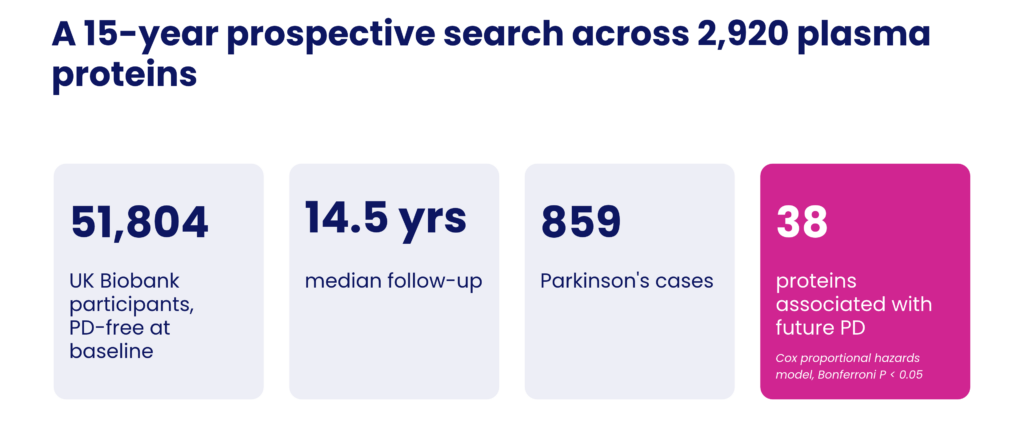
Reference: Gan Y-H et al. Large-scale proteomic analyses of incident Parkinson’s disease reveal new pathophysiological insights and potential biomarkers. Nature Aging 5, 642–657 (2025).
What other diseases are linked to these Parkinson’s-associated proteins?
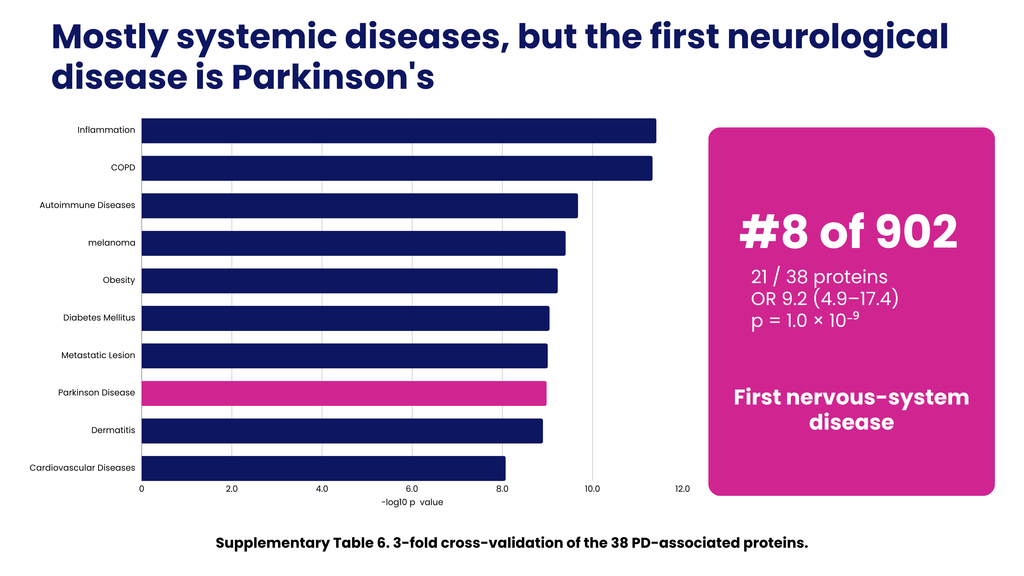
A disease enrichment analysis of the 38 proteins was dominated by inflammation, immunity, and metabolic disease, alongside several respiratory and cancer terms:
• 28 of the 38 proteins are associated with inflammation.
• 25 are associated with melanoma, and 23 with diabetes mellitus.
• Autoimmune diseases, systemic lupus erythematosus, dermatitis, and colitis are also strongly enriched.
• A further group, including ITGAV, ITGA11, TNXB, and PEPD, points towards fibrosis and tissue remodelling.
Two of these are not incidental. Melanoma and Parkinson’s co-occur more often than expected, with shared genetics in pigmentation biology. Type 2 diabetes is associated with higher Parkinson’s risk and faster progression, and has motivated GLP-1 receptor agonist trials in Parkinson’s. The enrichment is picking up connections the field is already pursuing.
Parkinson’s disease ranked in the top 10 of more than 900 enriched disease terms.
Part of this pattern is expected. Plasma proteins reflect systemic biology, and broad terms such as inflammation are linked to thousands of genes in the literature, so well-studied proteins tend to land in them. But it also shows that the signature carries more than the processes traditionally associated with Parkinson’s.
When evaluating candidate biomarkers, this distinction matters. A protein can be associated with future Parkinson’s disease without being exclusive to it. Understanding its wider disease associations can help frame follow-up questions: does it reflect a process involved in Parkinson’s specifically, a shared mechanism across conditions, or a broader change in physiological state?
Are these proteins specific to Parkinson’s disease?
Inflammation, immune activation, and metabolic dysfunction are not exclusive to Parkinson’s disease, and the 38 proteins reflect that overlap. ITGAM and ITGB2 form the Mac-1 integrin, expressed by microglia and monocytes. CLEC4C, CLEC10A and CD209 are associated with dendritic cells, and IL13RA1 participates in cytokine signalling.
This does not weaken the original findings. The prospective study shows that these proteins are associated with future Parkinson’s disease. But an association with future Parkinson’s does not mean the underlying biological signal is unique to it. The proteins may reflect early processes involved in the development of Parkinson’s, including systemic inflammation or metabolic change; they may reflect broader physiological states that raise the risk of several diseases; or both.
DISGENET cannot tell us whether the same signature would also predict diabetes or autoimmune disease in the same cohort. But it suggests that this is worth testing. UK Biobank records those outcomes, and the reported analysis focused on Parkinson’s disease.
How strong is the association with Parkinson’s disease?
Although systemic and inflammatory conditions dominate the results, Parkinson’s is the first nervous-system disease in the ranking. Twenty-one of the 38 proteins have Parkinson’s associations in DISGENET.
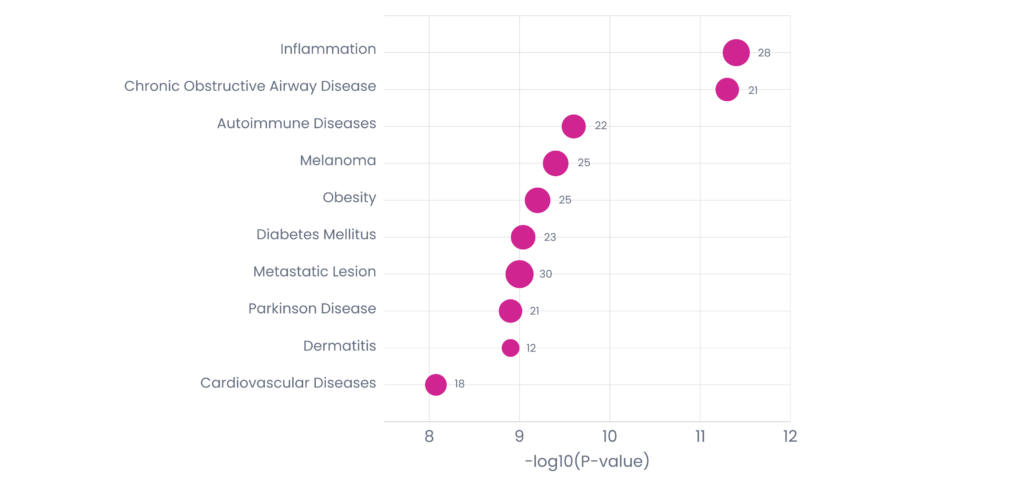
The signature therefore overlaps substantially with systemic disease biology, yet Parkinson’s emerges as its leading neurological association. Biological relevance and disease specificity are not the same thing.
How strong is the evidence linking each protein to Parkinson’s?
Of the 38 proteins, only a handful, including HNMT, RET, and NEFL, have substantial existing evidence connecting them to Parkinson’s disease. Another 16 have weak or indirect evidence, often only a few publications, many of them recent or based on animal models.
And 17 of the 38 proteins have no Parkinson’s evidence in DISGENET at all.
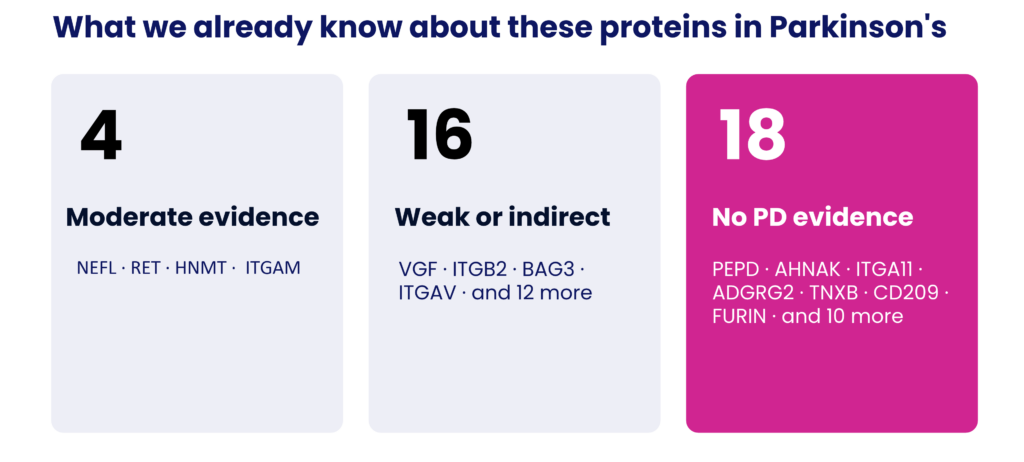
That last group is not a set of unknown proteins. Several have well-established roles in other diseases: TNXB in Ehlers-Danlos syndrome, PEPD in prolidase deficiency, CD209 in viral infections such as dengue and HIV, and FURIN in coronary artery disease. They have simply not been linked to Parkinson’s.
These proteins are a different kind of finding from established Parkinson’s genes such as SNCA, GBA1, LRRK2, PRKN or PINK1, which are supported by extensive genetic, clinical and experimental evidence. Rather than adding names to a list, the study may be pointing to underexplored connections between systemic biology and Parkinson’s disease that are worth investigating.
When prioritising candidates for further investigation, these differences in evidence coverage can be as informative as the associations themselves. A protein supported by extensive genetic evidence raises different questions from one linked to Parkinson’s through a small number of recent publications — or one with no recorded association in the database.
Can a well-established biomarker still lack disease specificity?
NEFL, the gene encoding neurofilament light chain, has substantial evidence connecting it to Parkinson’s disease. In DISGENET, it has a score of 0.60 and 156 Parkinson’s evidence records, 134 of which describe it as a biomarker.
But NEFL is associated with 1,012 diseases in DISGENET, including 490 mental or nervous-system disorders. That makes biological sense: neurofilament light chain is a marker of neuronal injury and neurodegeneration in general, not of Parkinson’s in particular.
HNMT offers a contrast. It has a higher score (0.80), and most of its evidence concerns genetic variants, mainly the protective Thr105Ile allele.
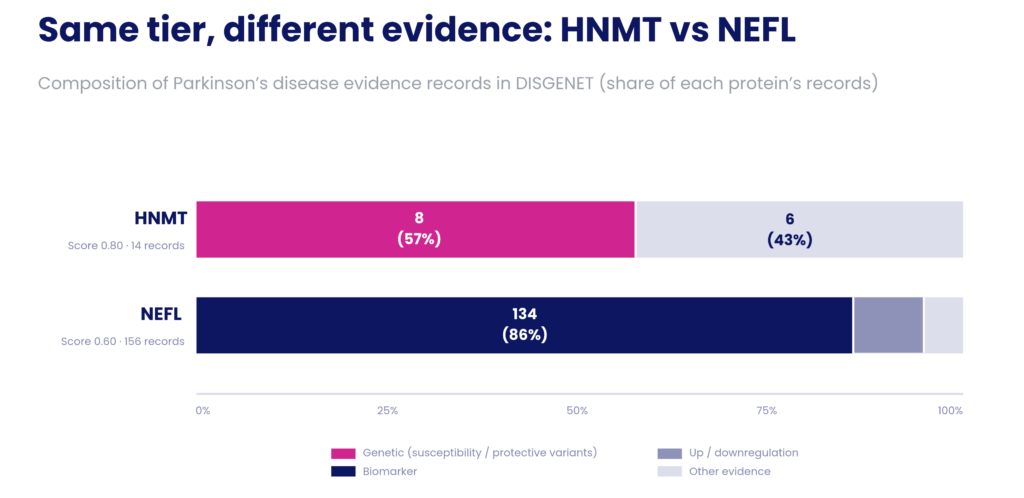
Both proteins are associated with Parkinson’s, but one rests mainly on genetic evidence and the other on biomarker evidence. Neither the number of associations nor an overall score can, on its own, tell us how specifically a protein identifies Parkinson’s disease.
From associated proteins to understanding the signal
Large-scale proteomics is transforming our ability to identify molecular patterns associated with future disease, and the Gan et al. study is an important example.
Our DISGENET analysis adds a second layer of interpretation. The 38 proteins are strongly connected to inflammation, metabolism, and immune-related conditions, while Parkinson’s remains the first neurological disease to emerge. Their evidence profiles range from well-established Parkinson’s associations to potential connections with Parkinson’s that are not yet represented in current disease knowledge.
This suggests that the signature captures both shared systemic biology and Parkinson’s-related processes. How much of the signal is specific to Parkinson’s, and how much reflects broader disease biology, remains an open question.
DISGENET helps move from finding a molecular signature to understanding what biological and disease context that signature actually represents.