
Modern psoriasis therapies have transformed patient care. From TNF inhibitors such as etanercept (approved for psoriasis in 2004) and infliximab (2006) to secukinumab (2015, targeting IL17A) and guselkumab (2017, targeting IL23A), advances in understanding disease biology have led to more targeted treatments.
Their success raises a question: how can we build on what we already know to explore the next therapeutic opportunities?
For World Psoriasis Day, we explored how gene-expression changes in psoriatic skin and how these findings connect with existing evidence on psoriasis.
We started by reviewing 35 publicly available psoriasis studies, covering different tissues, treatment responses, and comparisons between disease conditions. We then focused on 17 studies comparing psoriatic skin with healthy or unaffected skin, looking for gene-expression changes that appeared consistently across studies and exploring their potential therapeutic relevance with DISGENET, a disease genomics intelligence platform.
Does gene expression predict therapeutic relevance?
Some successful drug targets are strongly upregulated in psoriatic lesions. IL17A rises approximately 90-fold in our data and is upregulated in 15 of 17 skin studies; IL12B, IL23A, and IL17F also show recurrent increases. Yet TNF changes only about 1.4-fold, while TYK2, targeted by deucravacitinib, barely changes.
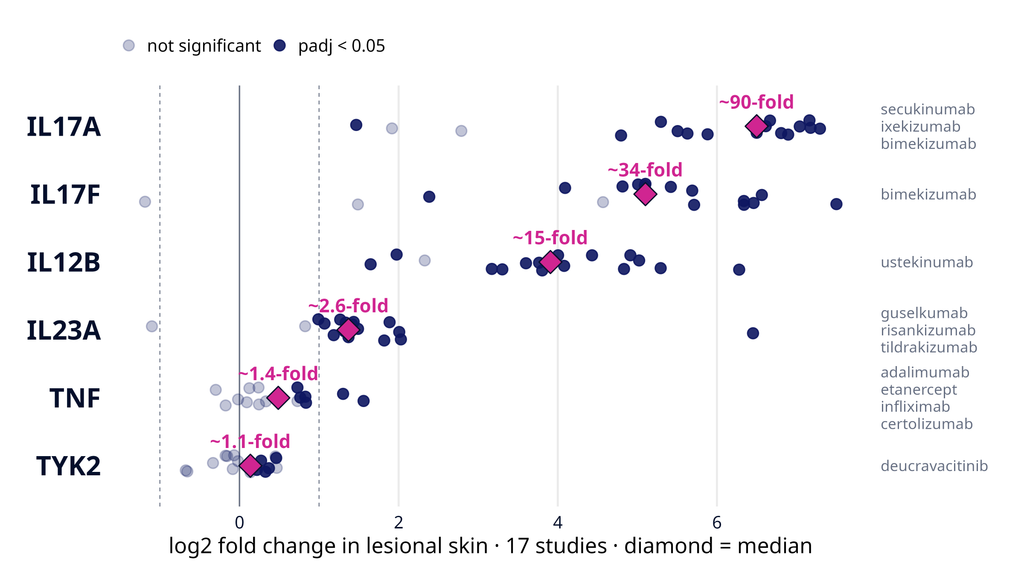
Why? A protein can be therapeutically important because of what it does, not how much its gene is expressed. TYK2, for instance, transmits inflammatory signals through its kinase activity. The strength of a transcriptomic change is therefore not a measure of how effective blocking that protein might be.
Looking beyond established therapeutic targets
We then used DISGENET to identify genes that researchers have explored as potential therapeutic targets for psoriasis and asked which of them also showed consistent changes in psoriatic skin. Consistent changes across independent studies make these genes particularly interesting to investigate further, although they do not necessarily make them more promising therapeutic targets. Genetic, mechanistic, and therapeutic evidence is essential to assess their potential.
This exploration highlighted 145 genes with recurrent expression changes. We selected three examples that illustrate different biological mechanisms, levels of supporting evidence, and opportunities for further investigation.
NOS2: a strong and reproducible signal in psoriatic skin
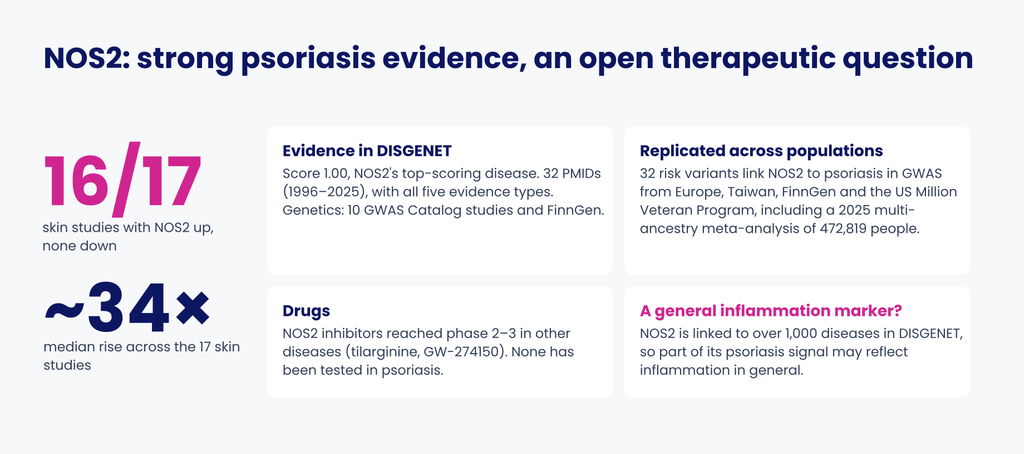
NOS2 encodes inducible nitric oxide synthase, an enzyme involved in inflammatory responses. It is upregulated in 16 of 17 skin studies, by approximately 34-fold. DISGENET also links NOS2 to psoriasis through extensive disease evidence, including ten genome-wide association studies. NOS2 inhibitors have already been investigated in other conditions. Could targeting NOS2 offer a new therapeutic strategy for psoriasis, given its strong and reproducible upregulation in affected skin?
PCSK9: exploring the link between psoriasis and lipid metabolism
PCSK9 is best known for regulating cholesterol levels and is already targeted by approved drugs such as alirocumab and evolocumab. But its role may extend beyond lipid metabolism.
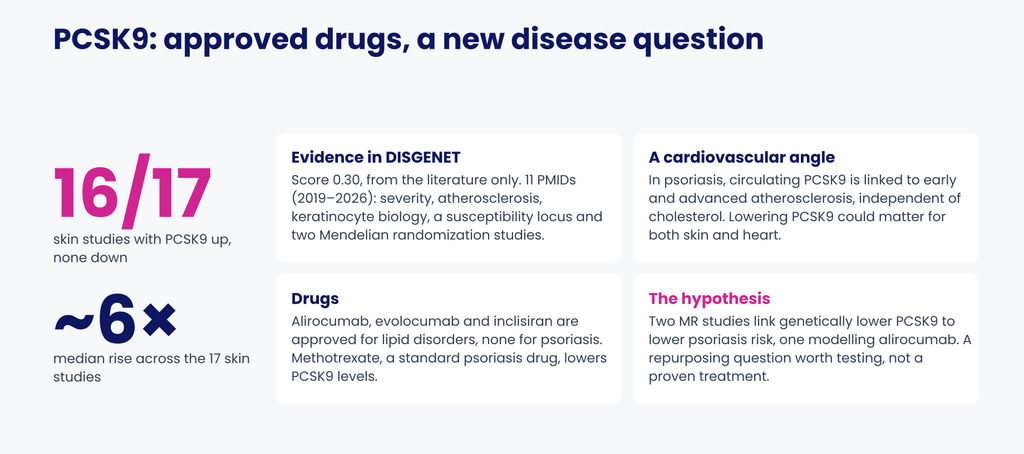
In our analysis, PCSK9 was upregulated in 16 of 17 psoriasis skin studies, with an approximately sixfold increase.
DISGENET brings together 11 publications on PCSK9 in psoriasis, linking it to disease severity, cardiovascular risk and psoriasis-like inflammation in experimental models. Two Mendelian randomization studies point the same way: genetically proxied PCSK9 inhibition is associated with lower psoriasis risk — about 30% lower odds per standard-deviation reduction in LDL in UK Biobank, replicated in FinnGen (Zhao et al., 2023).
Together, these findings make PCSK9 an interesting candidate for therapeutic investigation.
IL17C: the keratinocyte side of a proven pathway
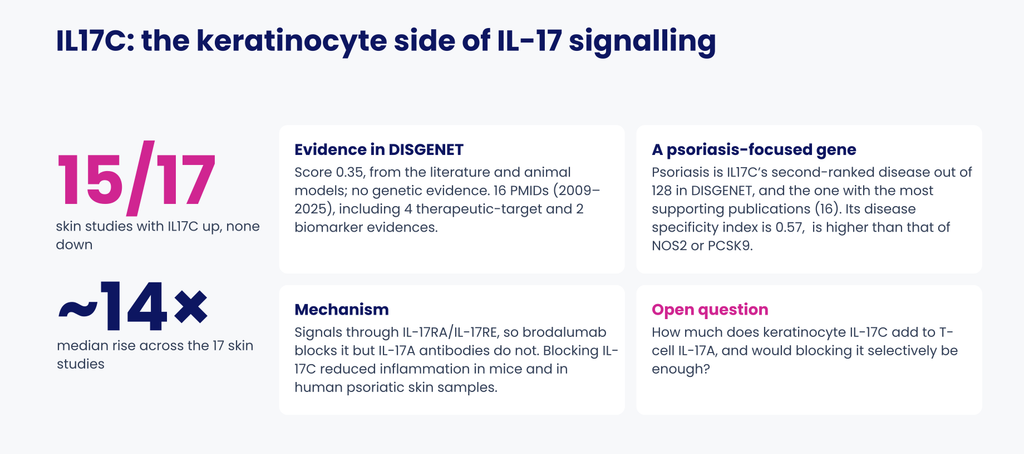
IL17C belongs to the IL17 cytokine family, but unlike IL17A, it is produced prominently by epithelial cells, including keratinocytes. Expression of the IL17C gene rises approximately 14-fold in 15 of 17 skin studies. IL17C signals through a receptor complex containing IL17RA, which is blocked by the approved psoriasis medicine brodalumab. IL17C levels in skin fall quickly under TNF blockade, and blood levels track response to systemic treatment.
This raises a question about the contribution of keratinocyte-derived IL17C to inflammation alongside immune-cell-derived IL17A—and how different parts of the IL17 family shape psoriatic lesions.
From psoriasis gene expression to new therapeutic hypotheses
The strongest expression change is not necessarily the most important therapeutic target. But a change that recurs across patient studies gives us a useful starting point. DISGENET adds the disease, genetic, and therapeutic context needed to ask what that observation might mean.
Figure 5 brings the pieces together. Approved psoriasis medicines act at several points of the IL23/IL17 pathway: on IL23, on TYK2 inside T cells, on IL17A and IL17F, and on TNF, which keeps inflammation going. The three genes we highlighted sit mainly on the skin side of this pathway:
- IL17C is made by keratinocytes and signals back through the IL17 receptor.
- NOS2 is strongly upregulated in psoriatic keratinocytes, where it drives nitric oxide production and may contribute to local inflammation.
- PCSK9 may connect skin inflammation with lipid metabolism and cardiovascular risk.
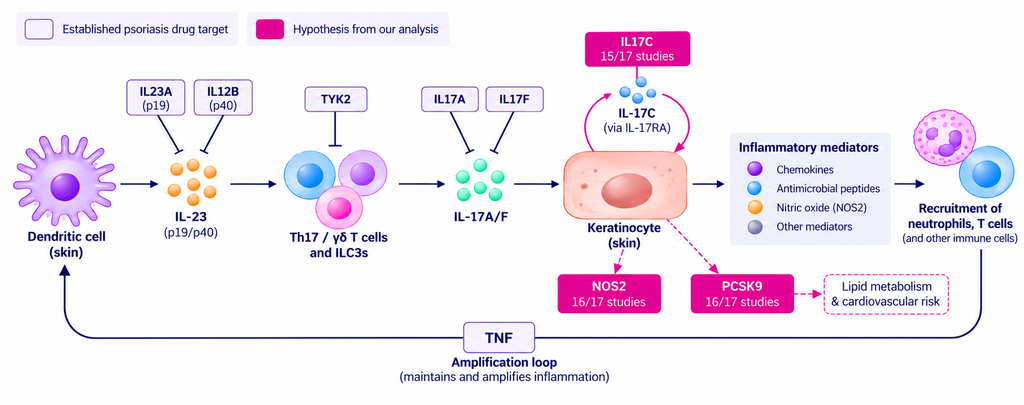
None of these genes is a validated new treatment for psoriasis. Together, they show how patient observations and accumulated disease knowledge can help guide what to investigate next.
Explore the evidence with DISGENET
DISGENET brings together structured, evidence-ranked genotype–phenotype and therapeutic knowledge to help scientists investigate disease associations and explore potential therapeutic opportunities.