
Elevated ALT, mitochondrial dysfunction, and acute liver failure are all “phenotypes”, but they mean very different things. Here’s why that matters for target discovery and safety assessment.
What Is a Phenotype? One Word, Very Different Biology
What do elevated liver enzymes, mitochondrial dysfunction, obesity, and acute liver failure have in common?
All can be described as phenotypes. Yet they represent very different biological characteristics, measured at different levels of organisation and used to answer different scientific questions.
In biomedical research, “phenotype” spans everything from molecular and cellular properties to physiological traits and clinical outcomes.
But not all phenotypes serve the same purpose. A molecular change may show target engagement, a physiological measurement may indicate disease progression, and a clinical outcome may assess therapeutic benefit or adverse effects.
A diagnosis gives researchers a useful clinical framework, but a disease label can’t capture every molecular process, physiological trait, or clinical manifestation connected to it. Phenotype context fills in that picture, but only if we can distinguish them. The way we represent them shapes the hypotheses we can build, in target discovery as much as in safety assessment.
From Genotype to Phenotype Across Biological Scales
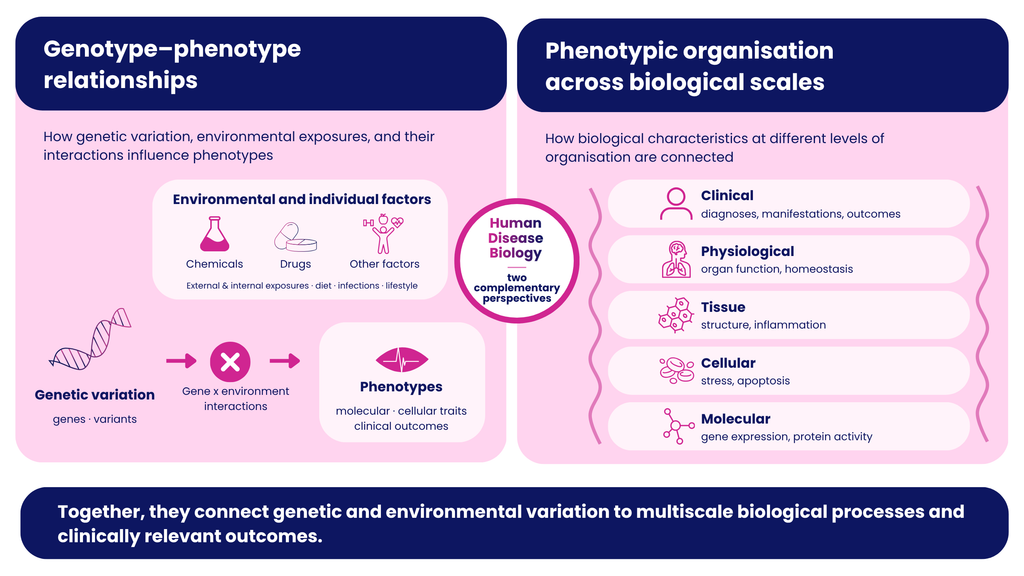
Genetic variation can be associated with molecular and cellular processes, tissue and organ function, measurable physiological traits, and clinical manifestations. Together, these levels form the genotype–phenotype spectrum across biological scales.
However, these relationships do not follow a simple, linear progression. Genetic effects emerge through interconnected biological processes and depend on cellular context, environmental influences, and interactions among genes and pathways. A single genetic variant may influence multiple phenotypes, while similar clinical manifestations may arise through different molecular mechanisms.
The line between genotype and phenotype isn’t just about scale. A DNA variant is genotypic information, but RNA expression, protein abundance, and enzyme activity are molecular phenotypes. That matters when integrating genetic evidence with functional genomics, in vitro data, and clinical observations.
Obesity shows how this plays out. It can be studied as a quantitative trait (BMI, adiposity) or as a clinical diagnosis. Neither is wrong, but each answers a different question.
The takeaway: different representations of the same biology are complementary, not interchangeable.
Types of Phenotype: Endotypes, Biomarkers, Endpoints and Endophenotypes
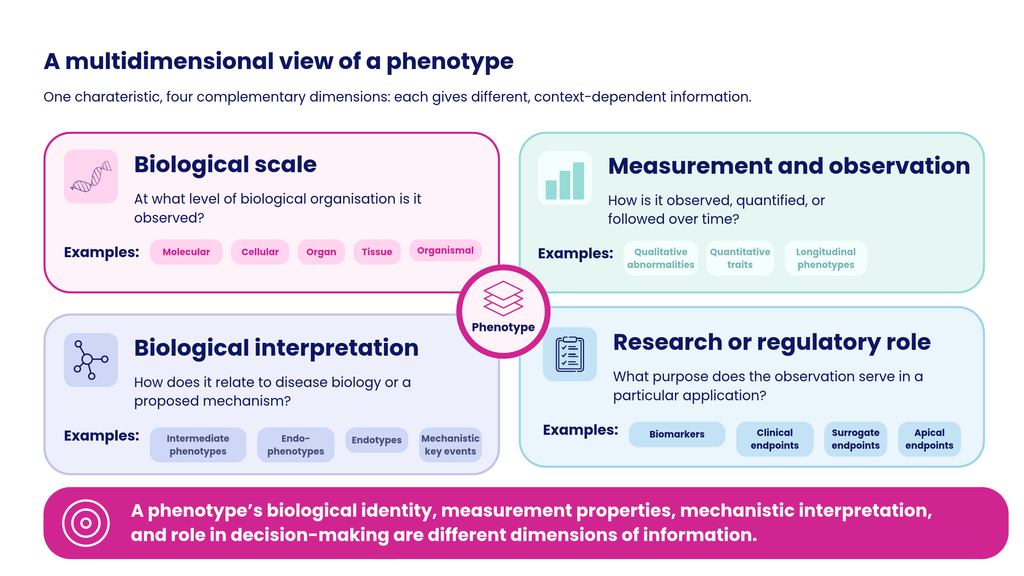
Beyond the biological scale, the same measurable characteristic can play very different roles depending on the question being asked. A few examples that matter most for R&D:
Intermediate Phenotypes
Measurable links between genetic variation and disease outcome. Circulating LDL cholesterol is a classic example. Labeling a phenotype “intermediate” doesn’t prove it mediates the effect causally.
Phenotypes vs. Endotypes
Clinical phenotypes describe how a disease presents. Endotypes group patients by underlying mechanism. Type 2-high asthma is a good example: the mechanistic subgroup has informed targeted biologic therapies in a way the clinical label alone could not.
Biomarkers and Surrogate Endpoints
The same quantitative trait (blood pressure, circulating ALT) can serve as a biomarker or a study endpoint, depending on context. A surrogate endpoint needs evidence that it predicts clinical benefit or harm.
Endophenotypes
Endophenotypes are measurable characteristics that reflect an underlying, often heritable, liability to a disorder. They offer a more tractable way to investigate genetic susceptibility than a heterogeneous clinical diagnosis. The concept grew out of psychiatric genetics (P50 sensory gating deficits in schizophrenia are a classic example), but the idea of looking beneath the diagnostic label applies across disease areas.
Key Events and Adverse Outcomes in AOPs
In safety science, the Adverse Outcome Pathway (AOP) framework links measurable molecular and cellular changes to adverse outcomes through evidence-supported key event relationships.
Phenocopies and Pleiotropy
Two further complications: similar phenotypes can arise from different mechanisms (phenocopies), and one genetic change can influence many phenotypes (pleiotropy). Phenotypes are also dynamic and vary with age, exposure, and disease stage, which matters when translating across experimental systems.
Why Phenotype Categories Overlap
These categories overlap and don’t form a single hierarchy. The same measurement can sit in several of them, depending on the evidence and the intended use.
A phenotype’s biological identity, how it’s measured, what it means mechanistically, and how it’s used in decisions are all different dimensions of information.
Drug-induced liver injury (DILI) illustrates why these distinctions matter.
Researchers investigating liver injury may examine mitochondrial dysfunction, endoplasmic reticulum stress, hepatocellular injury, circulating alanine aminotransferase (ALT) activity, or clinical outcomes such as acute liver failure.
These observations are related to liver biology, but they are not equivalent.
Mitochondrial Dysfunction and ER Stress in DILI
Mitochondrial dysfunction and endoplasmic reticulum (ER) stress can represent cellular perturbations involved in certain mechanisms of liver injury. However, stress responses may be adaptive or reversible, and their occurrence does not necessarily imply that clinically relevant liver damage will follow.
Elevated ALT as a Biomarker of Liver Injury
Elevated serum ALT is a widely used biomarker of hepatocellular injury, but it isn’t specific to DILI, doesn’t reveal the mechanism, and can’t establish severity or prognosis on its own. It’s a downstream indicator, not a causal mediator, which shows how a phenotype can be clinically informative without being a mechanism.
Acute Liver Failure (ALF) as a DILI Outcome
ALF is a severe clinical syndrome characterised by acute liver injury accompanied by coagulopathy and hepatic encephalopathy, generally in individuals without pre-existing cirrhosis. It has many possible causes, and while uncommon, it is a potentially life-threatening outcome of DILI.
Adverse Outcome Pathways (AOPs) in DILI
The Adverse Outcome Pathway (AOP) framework helps organize this mechanistic knowledge, but no single AOP captures every mechanism of DILI or every cause of ALF.
Why DILI Phenotypes Aren’t a Single Causal Pathway
The relationships among these observations are biologically important, but conditional rather than sequential. A chemical may induce mitochondrial stress in an experimental model without producing clinically relevant liver injury at anticipated human exposures. Conversely, clinically apparent DILI may arise through different mechanisms, including immune-mediated processes.
For drug discovery teams, these distinctions inform mechanistic investigation, biomarker selection and safety evaluation. A single “DILI” label can hide very different biology.
Four DILI-related phenotypes, four different meanings
| Biological observation | Biological level | Mechanistic interpretation | Research or clinical relevance |
| Mitochondrial dysfunction | Molecular / cellular | Potentially reversible; may contribute to hepatocellular injury | Mechanistic investigation; experimental safety assessment |
| ER stress | Molecular / cellular | Stress response that may be adaptive or contribute to injury, depending on context | Mechanistic investigation; experimental safety assessment |
| Elevated serum ALT | Biochemical / organismal | Primarily a downstream indicator of hepatocellular injury, not a causal mediator | Clinical biomarker; liver injury monitoring; study endpoint |
| Acute liver failure | Organ / organismal | Severe hepatic dysfunction through multiple possible mechanisms | Clinical syndrome; severe adverse outcome |
These observations aren’t consecutive stages of one causal pathway. They differ in scale, mechanism, and use.
NAMs and Beyond: Why Lab Phenotypes Don’t Always Translate to Humans
Translating observations from experimental models into insight about human disease and adverse outcomes is one of the hardest problems in R&D.
Conserved biology can look very different across species. Phenologs (phenotypes linked through shared orthologous genes, even when they look dissimilar) show how non-obvious relationships can point to useful models and new hypotheses. But a phenolog doesn’t prove the mechanisms are identical or that findings will carry over to humans.
New Approach Methodologies (NAMs), including human cell-based assays, organoids, omics technologies and computational models, can provide detailed information about molecular and cellular responses. However, a change observed in an experimental system doesn’t automatically predict an adverse human outcome. Relevance depends on the model, the exposure conditions, the size and duration of the response, and the evidence linking the perturbation to harm.
AOPs help place these observations in context, but they aren’t quantitative predictors of human risk. Safety decisions also depend on exposure, toxicokinetics, and variability, which is why approaches like Next Generation Risk Assessment (NGRA) integrate multiple lines of evidence.
The central challenge is not simply to identify molecular perturbations, but to determine which perturbations matter, under what conditions, and how confidently they can be linked to adverse outcomes in humans.
Phenotype Ontologies: Why Standard Terms Aren’t Enough
Ontologies such as HPO, EFO, and OBA, and frameworks like UMLS, are essential for organizing phenotype data. They tell us what kind of observation we’re looking at. But connecting concepts across terminologies is necessary, not sufficient. Semantic links aren’t the same as causal or experimentally established biological relationships.
Consider a record describing elevated serum ALT activity. To interpret its significance, we may also need to know:
- Whether the measurement comes from a human patient, an animal model, or another experimental system
- Whether it represents a baseline characteristic or a response to an intervention
- Its magnitude, timing, and relationship to exposure
- Whether it is being used as a biomarker, study endpoint, or part of a clinical assessment
- What evidence supports its association with a disease, mechanism, or adverse outcome
A standardized term identifies the type of observation. Its context, supporting evidence, and relationships to other observations determine how it can be interpreted. Resources that connect genetic variants, phenotypes, diseases and evidence are only as useful as the meaning, provenance and uncertainty they preserve. Representing an association isn’t the same as establishing causation.
Implications for Target Discovery, Indication Selection and Drug Safety
Here’s how richer phenotype context changes the questions R&D teams can ask.
Target Discovery and Prioritization
Integrating genetic associations across diseases, phenotypes and traits can reveal new biological hypotheses, highlight shared mechanisms and help build the rationale for why a gene matters in a given disease context.
Indication Selection and Drug Repurposing
Genetic evidence tied to phenotypes shared across diseases can point to opportunities beyond established diagnostic categories, although shared associations don’t prove a common mechanism or predict efficacy.
Drug Safety Assessment
Connecting experimental phenotypes to mechanisms and clinically relevant outcomes, with exposure and context in mind, is essential to judging how relevant NAM-generated evidence is to humans.
Complex Disease and Precision Medicine
Richer phenotypic characterization can reveal biologically meaningful patient subgroups and shape which genetic associations are found and how they’re interpreted. Showing a difference in treatment response still requires further evidence.
Why Phenotype Context Matters in Drug Discovery and Safety
Phenotypes aren’t just labels attached to diseases. They’re complementary views of biology, from molecular characteristics to clinical outcomes. A diagnosis gives you a starting point, and connecting evidence across the genotype–phenotype continuum is how you explore the biology beyond it.
Capturing this diversity requires more than extensive terminology coverage. The challenge isn’t simply finding more associations. It requires knowledge infrastructures capable of representing biological context so you can explore the relationships between them, with the context and evidence intact.
As R&D increasingly combines human genetics, multi-omics, mechanistic models and AI, the quality of phenotype representation matters more. The goal isn’t to connect more data. It’s to preserve enough biological meaning to tell an observation from a mechanism, a biomarker from an outcome, and an association from a causal relationship.
That distinction can make the difference between generating more hypotheses and generating evidence that genuinely informs R&D decisions.
At DISGENET, we’ve been working on making more of the relationships between genes, phenotypes, and diseases available to explore. Follow along as we share what’s next.