
Turning complex biomedical evidence into actionable insights should feel intuitive — not overwhelming.
With DISGENET v25.4, we focused on features that make your daily workflows more customizable, more reproducible, and easier to share, without sacrificing depth, evidence quality, or analytical power.
DISGENET v25.4 includes:
- My Score — customizable evidence ranking to tailor GDA and VDA scoring to your team’s criteria.
- Saved Searches to make complex exploration reusable and reproducible.
- Shareable URLs so colleagues see exactly the same filters, metrics, and table views.
- ClinPGX integration adds high-confidence pharmacogenomic evidence.
- Web-Based Disease Enrichment Analysis for code-free interpretation of gene or variant lists.
My Score: Your Evidence, Your Ranking
Different use cases require different evidence sources.
Some need expertly curated resources. Others rely heavily on large-scale population studies, pharmacogenomics data, or the latest data from scientific literature.
DISGENET v25.4 now lets YOU decide what matters most.
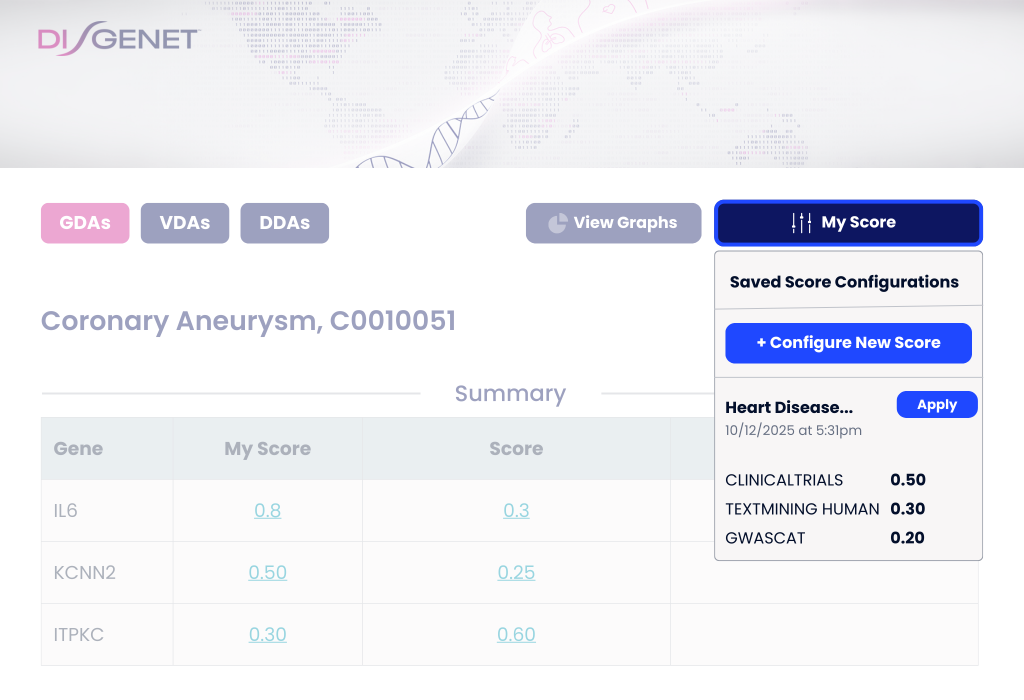
With My Score, you can:
- Select the most relevant sources – GenCC, ClinVar, UniProt, Clinical Trials…
- Assign custom weights to each one
- Let DISGENET automatically compute a personalized GDA/VDA score
- Save your weights and reapply your score across future datasets or disease evaluations.
This means your scoring method:
- Tailors the weighting methodology to your use case’s requirements.
- Stays consistent across teams and projects
- Dynamically filters associations
- Makes prioritization reproducible and transparent
Whether you’re ranking drug targets, filtering variant hits, or evaluating biomarkers, My Score aligns DISGENET with your scientific needs — not the other way around.
My Score is available on Standard & Advanced plans
Save Customized Searches — And Reuse Them Anytime
Many analyses need to be repeated, reproduced, or shared across teams.
Before v25.4, that meant re-applying filters, reselecting columns, and reconfiguring table views every time you returned to the platform.
Now, DISGENET does the remembering for you.
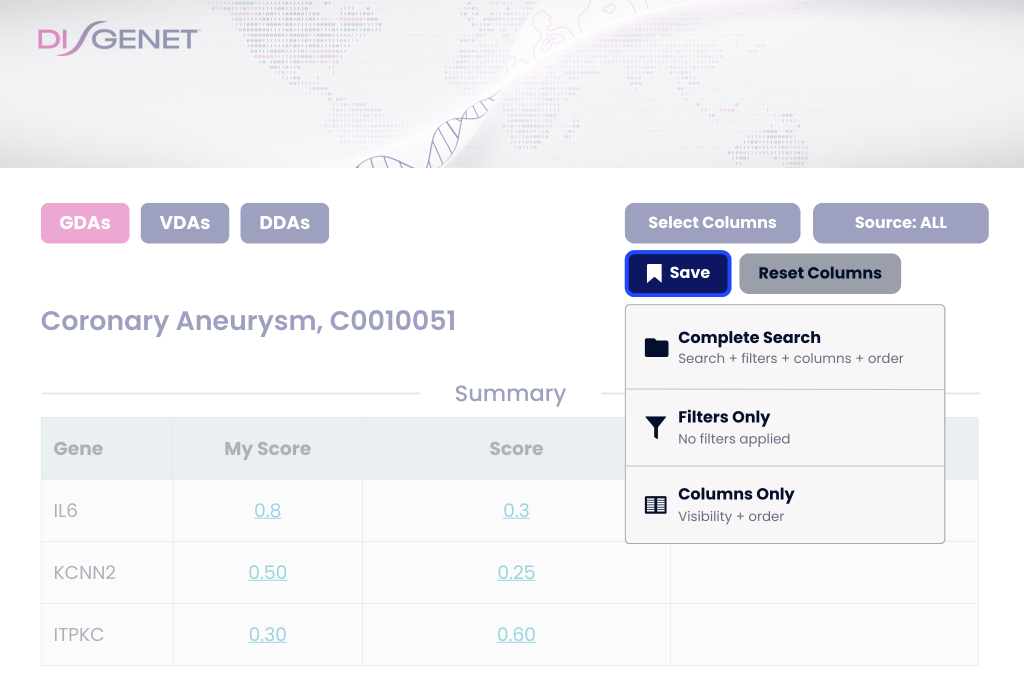
You can now save:
- All applied filters
- Selected columns and metrics
- Sorting preferences
- Table layouts
- Full search configurations
- My Score weights
Come back tomorrow, next quarter, or after a team handover — your entire setup is restored instantly.
And now, all your saved searches, filters, and table views are neatly stored in a new Favorites section inside the user profile. In addition, they also appear on top of the summary table after starting your search. This makes it easy to revisit, manage, and organize your most important workflows in one place.
This is especially useful for:
- Standardized target prioritization criteria
- Disease-specific variant review workflows
- Evaluating Biomarkers
- Collaborative research across institutions
Saved Searches are available on Standard & Advanced plans
New Curated Source: ClinPGX
DISGENET v25.4 now incorporates ClinPGX, an established clinical pharmacogenomic (PGx) resource created to support and expand PGx knowledge, implementation, and education.
ClinPGX brings high-confidence evidence describing how genetic variants influence drug response, including:
- Toxicity
- Dosage
- Efficacy
- Metabolism / PK (pharmacokinetics)
- PD (pharmacodynamics)
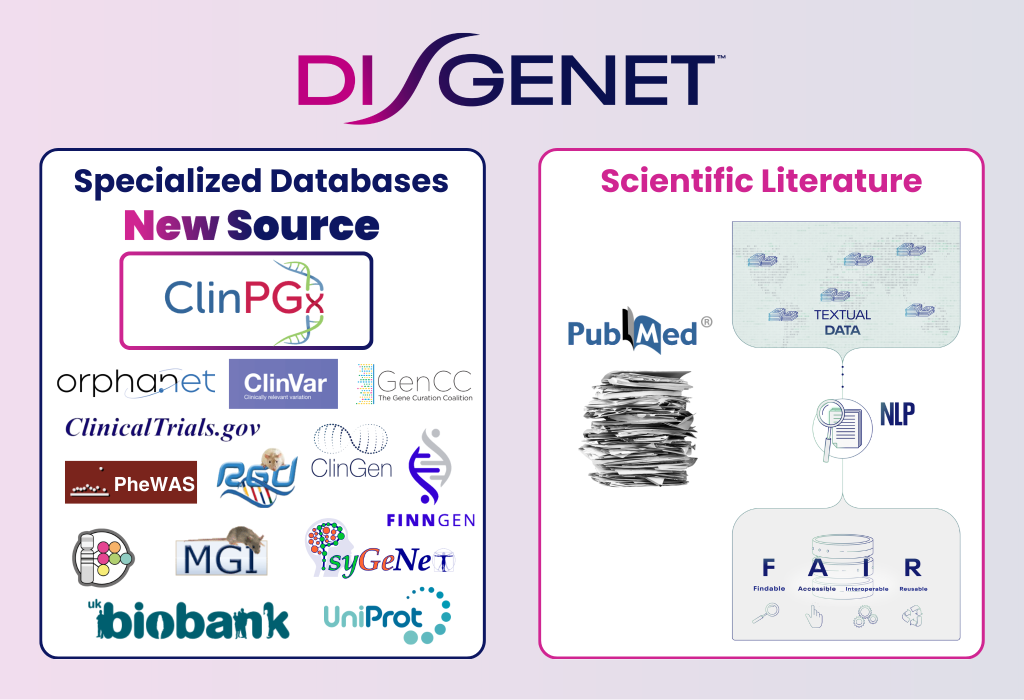
This new source enriches both gene–disease (GDA) and variant–disease (VDA) associations with clinically meaningful context, expanding the relevance of DISGENET for teams working at the intersection of genetics and therapeutics.
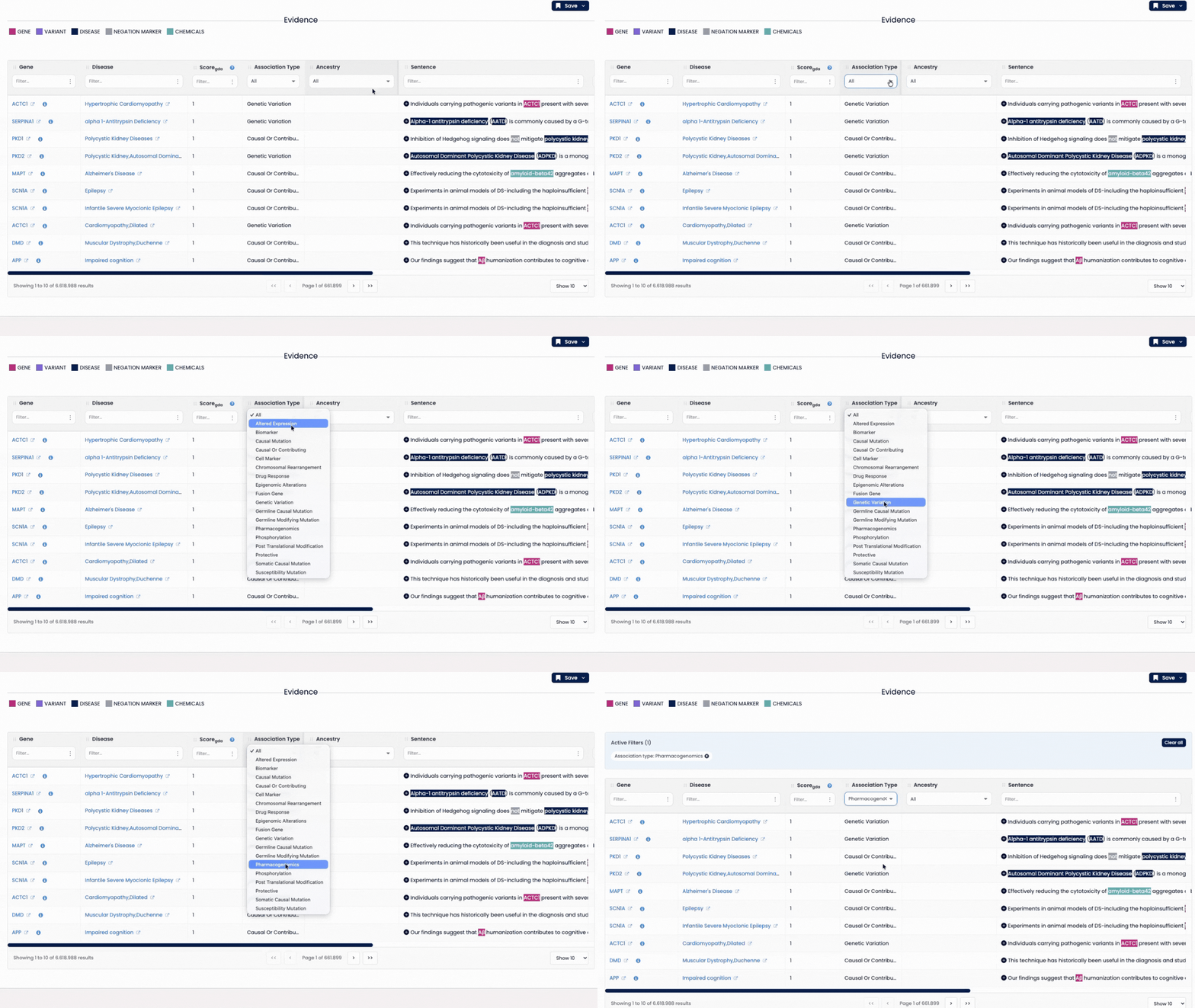
You can now filter associations by the “Pharmacogenomics” association type, or use CLINPGX as a data source, enabling faster identification of variants that alter treatment outcomes or highlight patient-specific risks.
To make drug–disease relationships more interpretable, v25.4 expands its classifications of Chemical Effect that classifies how a chemical (typically a drug or compound) interacts with a disease.
With Chemical Effect, you can now distinguish between:
- Therapeutic — Variants in genes that are targets of the drug or directly involved in the mechanism of action for treating or alleviating the disease.
- Toxicity — Variants in genes associated with adverse drug reactions or increased risk/severity of toxicity when taking the medication.
- Dosage — Variants in genes associated with the amount of drug needed to achieve a therapeutic effect or to avoid toxicity; these variants influence recommended dosing adjustments.
- Efficacy — Variants in genes associated with the effectiveness of a drug, including whether a patient is likely to respond, not respond, or require alternative therapy.
- Metabolism/Pharmacokinetics (PK) — Variants in genes associated with the absorption, distribution, metabolism, or excretion of the drug; these variants affect drug levels and how quickly the drug is processed in the body.
- Dosage Efficacy Metabolism/PK – Combined cases where variants influence multiple pharmacogenomic dimensions at once. These relationships highlight variants with broader impact across treatment response.
This allows you to filter chemical–disease relationships not just by association, but by mechanistic intent and clinical impact, making it easier to prioritize drugs with therapeutic potential or exclude compounds with known toxicity risks.
Share Insights With One Link
With DISGENET v25.4, every configured table view, search, filter combination, or My Score weights can be shared as a single URL. Your colleague opens the link and sees exactly what you see.
This feature makes collaboration easy for:
- Cross-functional teams (bioinformatics ↔ translational ↔ therapeutic area)
- Code-free reviews with clinical genomics teams
- Internal presentations and decision meetings
- External partners, collaborators, or CROs
Disease Enrichment: Powerful Insights, Zero Coding Required
You shouldn’t need to write scripts or build workflows just to understand what your gene or variant list means.
Now, you don’t have to.
The Disease Enrichment Analysis feature converts raw lists into high-level, disease-focused insights instantly.
Paste your list and immediately see:
- The most strongly associated diseases
- Significance metrics
- Evidence supporting each association
- Visual plots and exportable tables

It’s ideal for making sense of:
- RNA-seq hits
- CRISPR screens
- GWAS findings
- Patient-derived variants
- Gene panels
- Prioritized candidate sets
With one click, you can transform a plain list into a biological narrative.
Designed for Faster, Smarter Insights
DISGENET v25.4 is built for scientists who want powerful capabilities without friction — enabling faster, clearer, and more confident decision-making across the entire discovery pipeline.