The DISGENET free academic license is a good place to start your research. You will know it is time for more when a search comes back with few or no results, a gene you expected is missing, or you want to access evidence from the latest scientific publications.
Why upgrade? DISGENET upgraded access gives you more evidence on every disease, more ways to weigh it, and more ways to work with it.
The clearest way to see the difference is to run the same search on both.
Same search, two views: a PCOS example
Our example is polycystic ovary syndrome (PCOS). In May 2026, The Lancet published a global consensus that renames it polyendocrine metabolic ovarian syndrome (PMOS). The old name pointed to one organ and to cysts that are not actually increased. It hid a condition involving insulin, androgen, and neuroendocrine disturbances, with metabolic, cardiovascular, reproductive, psychological, and dermatological features.
So what does the genetic evidence in DISGENET show? We searched PCOS twice: once with the free academic license, once with the full dataset available through a Standard or Advanced plan.
PCOS: With the DISGENET Free Academic License
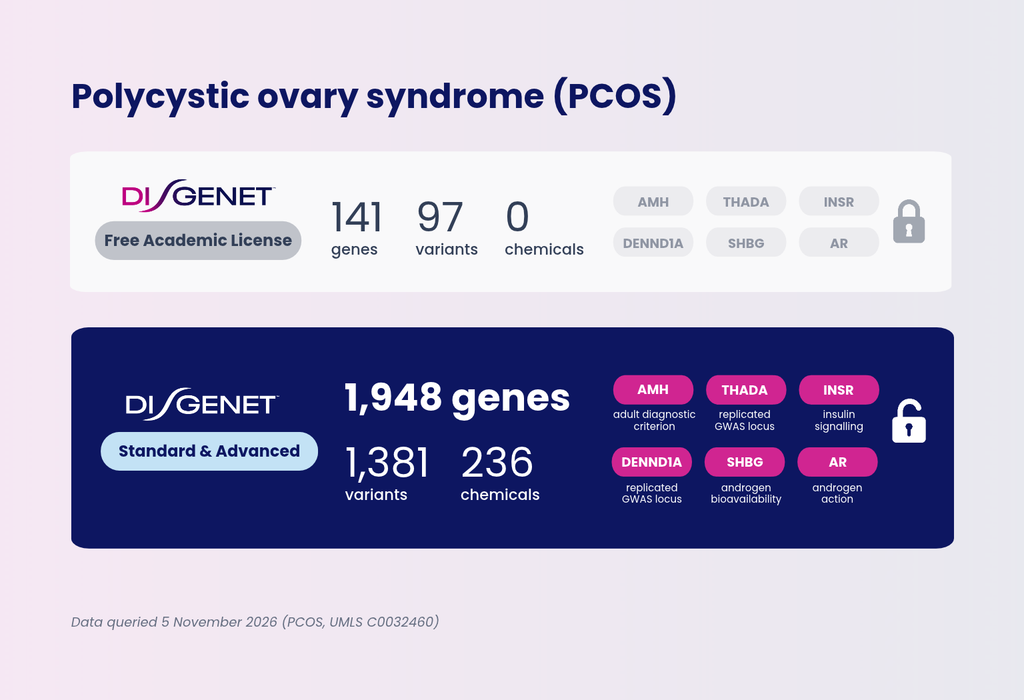
You get expert-curated associations for 141 genes, and the top of the list is sound biology. INS, CYP19A1 and LEP point to insulin and steroid signaling, and FSHR, BMP15 and GDF9 to follicle development. It is a credible place to start.
But several genes that matter for how PMOS is now understood are not in this view:
- AMH, now part of the adult diagnostic criteria.
- DENND1A and THADA, two of the best-replicated PCOS GWAS loci.
- INSR, SHBG and AR, the insulin and androgen axis that “polyendocrine” refers to.
A PMOS gene list built from the free academic license view alone would start without these key genes since curated sources take time to review and update, so newer findings are not always included in them yet.
PCOS: With the full DISGENET dataset (available on Standard and Advanced plans)
Search the same disease with full DISGENET access across all sources, and it connects to 1,948 genes, nearly 14 times the free academic view, along with 1,381 variants, 236 chemicals, 346 clinical trials, and 3,796 publications.
- The missing genes appear, with their evidence. AMH, DENND1A, THADA, INSR, SHBG, and AR are all there. DENND1A alone has 273 supporting variants from GWAS Catalog and FinnGen.
- You can see how the evidence built up. Historical Score shows AMH–PCOS rising from 0.20 in 2003 to 0.60 in 2019, now backed by 255 publications and 57 clinical trials. That separates a signal that has held up for years from one that appeared last month.
- You can see where each gene’s associations concentrate. Gene Therapeutic Area Profiles place LHCGR and FSHR in endocrine and reproductive disease, and GIP and SLC2A4 in metabolic disease.
- You can see which diseases share the biology. PCOS shares genes with insulin resistance, cardiovascular disease, fatty liver disease, pre-eclampsia, and depression. That is the multi-system picture the new name describes, visible in the data.
The evidence you can reach decides how far your investigation can go.
Want the complete view for your own disease? Get Standard or Get Advanced
Which evidence sources DISGENET includes
The free academic license searches a selected set of expert-curated sources, where specialists review the evidence behind each association. DISGENET Standard and Advanced search those and the wider body of biomedical evidence available.
| Source group | Free Academic License | Standard and Advanced |
| Expert-curated sources, such as UniProt, ClinVar, ClinGen, GenCC, Orphanet and ClinPGX | Included ✅ | Included ✅ |
| GWAS, biobanks, phenotype and drug-target data | Not included ❌ | Included ✅ |
| Clinical trials | Not included ❌ | Included ✅ |
| Animal models | Not included ❌ | Included ✅ |
| Literature evidence from scientific publications | Not included ❌ | Included ✅ |
The kinds of evidence differ in strength, so every association shows its source and a score for you to weigh.
What upgraded DISGENET access lets you do
PCOS is one example. For any disease you research, upgrading your DISGENET account to Standard or Advanced lets you:
- Access the full evidence base with all sources. Your searches, your enrichment analyses, and every other feature draw on the full dataset, not a subset. Whatever you ask, the answer reflects all the evidence DISGENET holds.
- Find what curated databases have not picked up yet. Literature evidence is included from scientific publications, so you can see the most recent findings. Each association links to its supporting publications, and positive and negative findings are marked.
- Compare publications, biobanks, and trials side by side. Clinical trial annotations and biobank data sit next to the literature, so you can see whether an association rests on one kind of evidence or several.
- See how strong the evidence is, and how it is built up. The Score breakdown shows which sources drive an association’s score. Historical Score recalculates it using only the evidence available up to a year you choose, so you can tell a recent signal from one that has been building for years.
- Rank evidence your way with My Score. Pick the sources you trust most, give each a weight, and save the setup. A team focused on clinical relevance might weight GenCC and clinical trials. A variant study might lean on GWAS Catalog.
- Pick up where you left off. Save your searches, filters, and column layouts instead of rebuilding them each time you return to a long investigation.
- Weigh likely effect with LoF and GoF annotations. Variants carry loss-of-function and gain-of-function context, which helps you consider the likely direction of effect when you assess a gene as a target.
- Ask in plain English with AIDA. AIDA, the DISGENET AI assistant, turns a question into a structured query on DISGENET data across genes, variants, diseases, compounds, and therapies. No code needed.
DISGENET: Standard vs. Advanced
DISGENET Standard gives you the full evidence base on the web platform, with AIDA, My Score, saved filters, and Historical Score. Choose it if you work in a web browser.
DISGENET Advanced adds programmatic access through REST API, R package, Cytoscape App, and MCP Connector, all running on the full dataset.
You may already use some of these tools with the Free Academic License. Advanced lets you run the same scripts, networks and pipelines on far more evidence, and connect AI agents to DISGENET. Choose it if you script analyses in R, pull data through the API, build networks in Cytoscape, or work with LLMs.
See the bigger picture with full DISGENET access
Apply for your Free Academic license
Data queried 5 November 2026 (PCOS, UMLS C0032460).