
In this article, we cover:
- GTAP, a new profile that shows which therapeutic areas a gene is most strongly linked to
- Richer evidence context, with new metadata on disease model and sex/gender
- Five new association types for a more precise mechanistic picture
Every DISGENET release adds new ways to see the biology behind a gene–disease or variant–disease association. v26.3 continues that trend with three additions: a new way to profile a gene’s therapeutic relevance, richer context on the evidence behind each association, and a more precise vocabulary for describing how genes and variants relate to disease.
A New Lens on Gene–Disease Relevance: GTAP
Every gene in DISGENET is linked to one or more diseases — but a raw list of associations doesn’t tell you what kind of gene you’re looking at. Is it a specialist, concentrated in one corner of human disease? Or a generalist, showing up everywhere from cancer to metabolic disorders?
That’s the question the new Gene Therapeutic Area Profile (GTAP) answers. For every gene, GTAP compares how its associated diseases are distributed across major disease classes against the DISGENET background as a whole, surfacing which classes a gene is enriched in and which it’s conspicuously absent from. PCSK9, for example, comes back concentrated in Nutritional and Metabolic Diseases and Cardiovascular Diseases, exactly where you’d expect a cholesterol-regulating gene to land. While PSEN1 lights up almost entirely in Nervous System and Behavior and Mental Disorders — with Mental Disorders, Behavior and Behavior Mechanisms, and Nervous System all reaching significance — a profile that fits its role in Alzheimer’s disease and is depleted in many other classes (Immune System, Hemic and Lymphatic, Neoplasms, Digestive System all significantly negative). IL15, by contrast, shows the signature of an immune-signaling gene: significant enrichment in Infections, Immune System, and Hemic and Lymphatic diseases, alongside significant depletion in Congenital & Hereditary and Endocrine disease classes — a tight, immunology-specific footprint rather than a broad one.
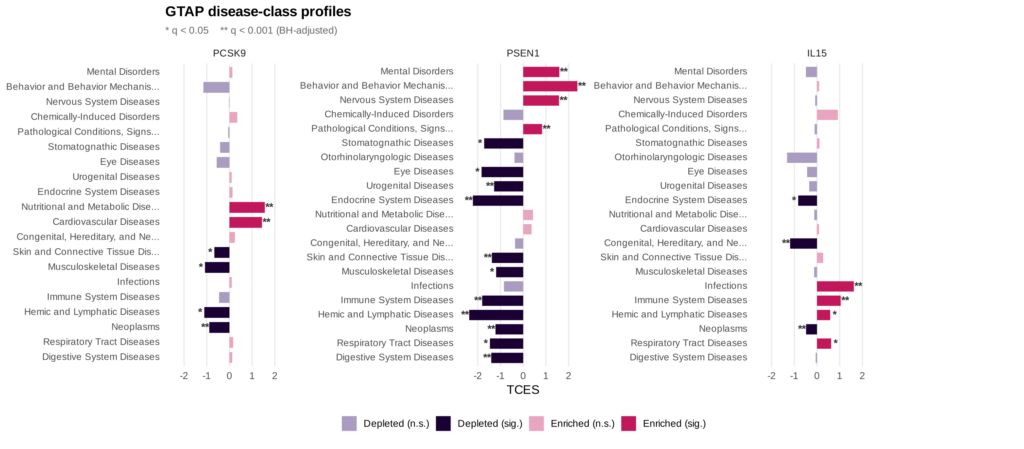
For the methodology, more examples, and how it complements existing metrics like DSI and DPI, read the full GTAP deep-dive →
Richer Context for Association Evidence
Not all evidence behind a gene–disease or variant–disease association is the same — a finding from a human clinical study carries different weight than one from a mouse model or a cell line. v26.3 makes that context explicit with two new metadata attributes:
- Disease Model — describes the biological or experimental system in which the evidence was generated: human subjects, animal models, cell lines, or other experimental systems.
- Sex/Gender — captures the sex or gender context described in the supporting publication, when reported.
Both attributes are extracted automatically from the scientific literature using our proprietary NLP pipeline, built specifically to identify and classify this kind of information, then normalized against controlled taxonomies for standardized identifiers and terms.
The practical upshot: associations can now be filtered and stratified by experimental model and by sex/gender context — useful for anyone vetting evidence quality or looking specifically at how well-represented certain models or demographics are in the evidence base.
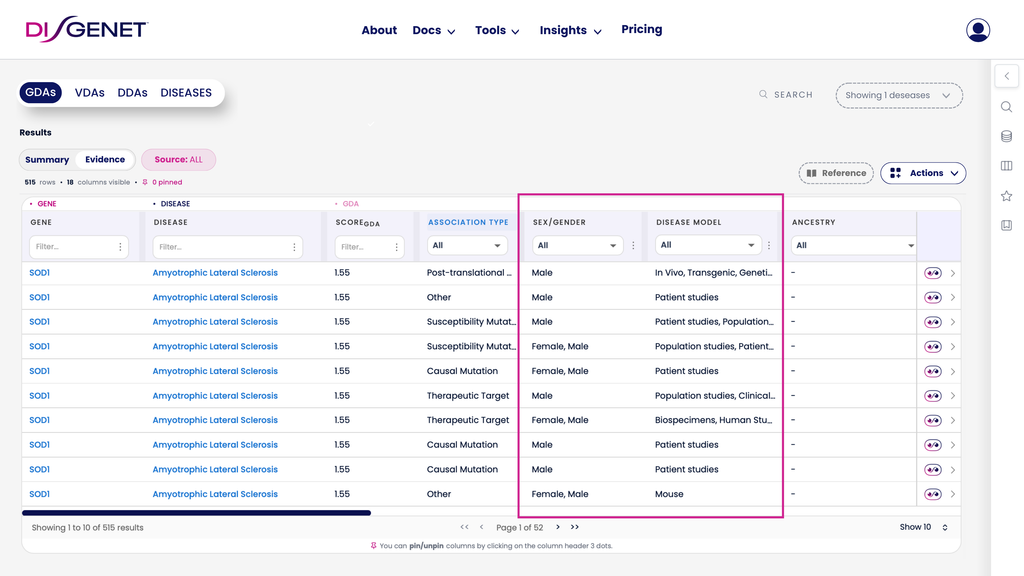
Take SOD1–Amyotrophic Lateral Sclerosis, one of the best-established gene–disease associations in ALS research. In the DISGENET evidence table, this single association is backed by evidence spanning patient studies, mouse models, and transgenic systems — with both male and female contexts represented across entries. Previously, that was a flat list of evidence rows. Now, disease model and sex/gender are visible as their own columns, so you can immediately see, for instance, how much of the support comes from human patient data versus animal models, or whether the evidence skews toward one sex.
Five New Association Types
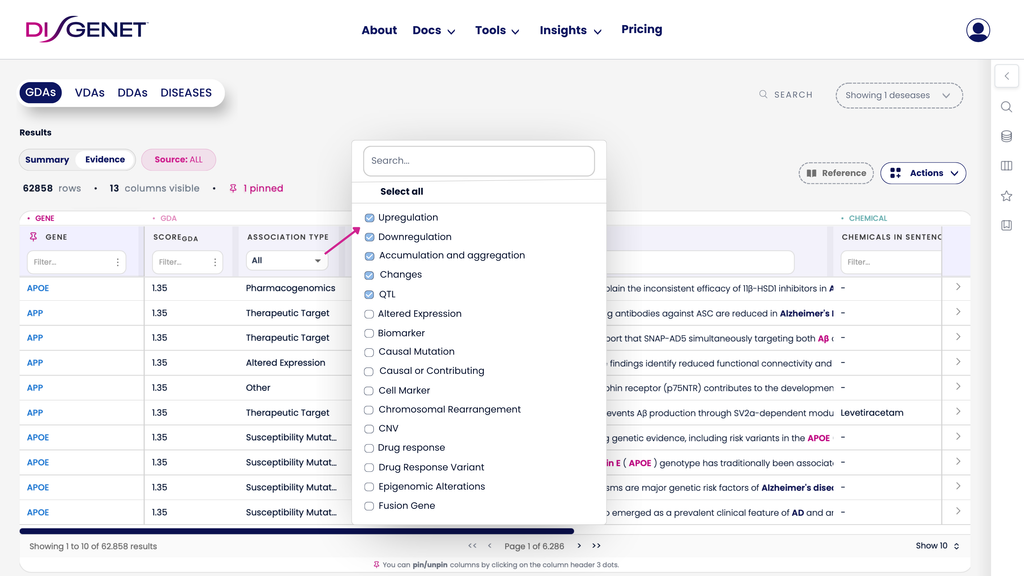
DISGENET has also expanded how it characterizes the biological relationship behind an association. v26.3 introduces new association types capturing:
- Upregulation
- Downregulation
- Accumulation and aggregation
- Changes in activity
- Quantitative trait loci (QTL)
These additions give a more precise picture of how a gene, variant, or its product relates to a disease or phenotype — extending the biological context available for interpreting and analyzing DISGENET associations.
DISGENET v26.3 now classifies gene and variant-disease associations across 30 distinct association types:
Try It Now
DISGENET v26.3 is live. Log in to explore GTAP profiles, filter association evidence by Disease Model and Sex/Gender, and uncover more precise biological relationships with 25 distinct association types.
More details about GTAP are available here